
Party Pros East Coast · Event Planning
Indoor Field Day Ideas for Schools: A Rain Backup Plan That Works
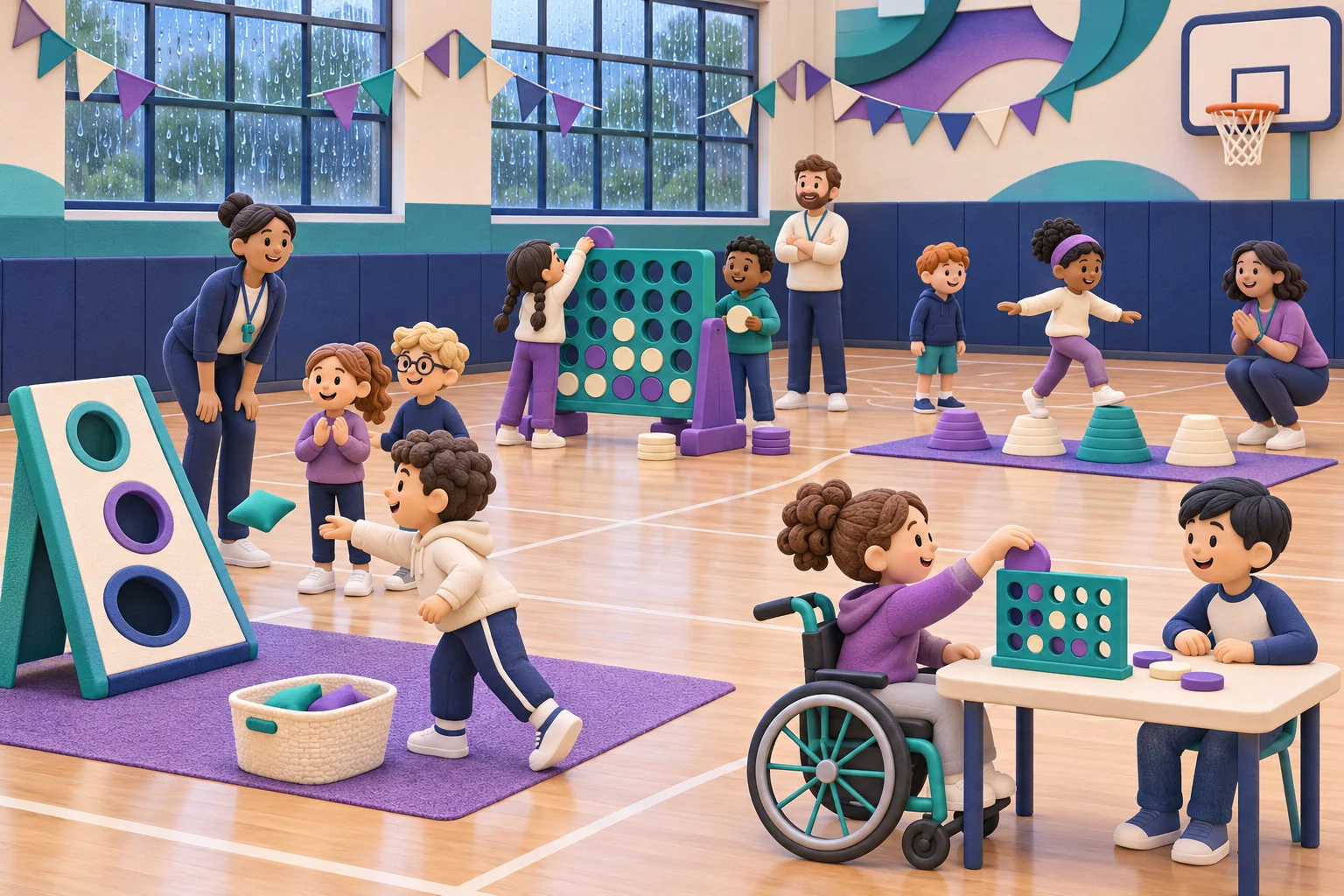
The most useful indoor field day ideas are activities your school can run in the rooms it actually has. When rain changes the outdoor plan, a manageable rotation of games can preserve the celebration without trying to squeeze the entire field into a gym.
For schools and PTO teams in Philadelphia, King of Prussia and surrounding communities, the best time to build the backup is before the weather forecast becomes the main topic of every planning meeting. Choose the indoor spaces, agree on who makes the decision and identify which activities can realistically move.
Decide what happens when the outdoor plan changes
Set a decision time with the school and rental provider, based on setup needs and the event schedule. Confirm who communicates the change to teachers, volunteers and families. Ask how the booking handles a move indoors, a postponement or a cancellation; do not assume those options are interchangeable.
Keep two approved activity lists: the outdoor plan and the indoor plan. Some equipment will not fit through the doors or operate in the available room. A rain backup may therefore need a different lineup, not simply a different location.
Indoor field day stations to consider
Mix movement, skill and quieter teamwork. The examples below include activities a school may already have supplies for, along with rental possibilities to discuss. Match each activity to the students, floor surface and available space.
| Station | Simple format | Planning detail |
|---|---|---|
| Beanbag target toss | Short turns with age-appropriate targets. | Use soft equipment and a clear throw-and-retrieve routine. |
| Cup-stacking challenge | Pairs build and reset a pattern. | Provide stable tables and enough sets for several pairs. |
| Giant Connect 4 | Pairs play while teammates suggest moves. | Offer parallel boards or a second task if the group is large. |
| Walking relay | Students carry or pass a soft object through a marked route. | Let school staff approve the route and movement rules. |
| Team puzzle | Small groups complete a shared visual challenge. | Use a table or seated format with reachable materials. |
| Carnival skill game | Brief rounds at a suitable booth-style game. | Confirm indoor suitability, setup footprint and supervision. |
For rental possibilities, browse the Philadelphia school field day lineup. Choose only items confirmed for your indoor site; the page also includes outdoor attractions that may not suit a gym.
Build the rotation around station capacity
Start with the largest group each station can meaningfully serve. If only two children can play while the rest wait, a class-sized group may need duplicate equipment, short partner tasks or a different activity. Attendance alone does not tell you how many stations you need.
Here is an illustrative rotation for six groups of ten students, provided every station is prepared to engage ten students through parallel activities or brief turns:
- 5 minutes for the welcome, group assignments and instructions.
- 6 rounds of 8 minutes at each station: 48 minutes total.
- 5 transitions of 2 minutes between stations: 10 minutes total.
- 5 minutes for the closing and return to class.
That example totals 68 minutes. It is a scheduling model, not a capacity guarantee or a required school timetable. Add water breaks and extra transition time where your students need them. For a larger school, repeat the program in waves instead of automatically increasing group sizes.
Make the room easy to understand
Use station names and numbers that match the teacher’s rotation sheet. Keep the entry, exit and walking route clear. Put activities that involve thrown objects away from queues and calmer table games. Let the school approve the layout and the maximum number of people in the space.
Plan a place for coats and wet belongings so they do not occupy the activity floor. Confirm floor protection for rental equipment and who will handle any wet entrances. Avoid adding food queues to a room that already has tight circulation.
Our school winter carnival guide offers a related approach to gym zones. Use this field-day plan for the weather decision, activity substitutions and class schedule.
Give students more than one way to participate
Ask school staff which adaptations students need. Options might include a seated target game, shorter throwing distance, reachable materials or a partner role. Offer a quieter activity without making it feel like a penalty for opting out of a noisy station.
For younger grades, keep instructions short and demonstrations visible. Older students may enjoy team scores, but avoid formats that eliminate players early and leave them waiting for the round to end.
Separate teacher, volunteer and rental duties
Assign an adult to explain each station and someone to move each group between activities. Give volunteers a one-page brief with the game rules, reset routine and school contact. Confirm which adults supervise students and which people operate rental equipment.
Rental staffing depends on the item and is quoted separately. Do not assume an attendant can cover school-wide supervision or that a volunteer can operate equipment requiring a designated operator.
Indoor field day questions
Can inflatables move into the gym if it rains?
Only if the exact attraction and setup are approved for that indoor space. Confirm dimensions, overhead clearance, access, power and the provider’s installation requirements in advance.
What if we have only one small room?
Use smaller waves and compact table or target activities. Reduce the number of simultaneous participants to what the school approves rather than crowding every class into one session.
Should we rent every station?
No. School-owned activities can work alongside selected rentals. Use rentals where they add something your supplies cannot provide, and compare the complete delivery and staffing scope.
Plan both versions before field day
Ask Party Pros about your school field day. Send the date, school address and actual event ZIP code, grade range, attendance, indoor dimensions and outdoor plan. Include door measurements, setup windows and your rain-decision deadline so the team can discuss workable options.